What Do Millimetre Sizes Mean When Ordering Flexible Pipe
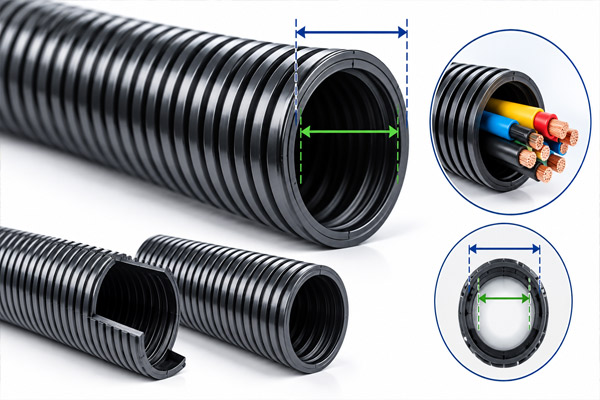
A flexible pipe measurement can describe its inner diameter, outer diameter or a nominal size. Before ordering, confirm which measurement the supplier uses. Inner diameter determines the space available for cables, while outer diameter affects fittings, clips and installation clearance.
This difference matters because two size keywords may refer to the same product. For example, a tube with a 6.4 mm inner diameter can have a 10 mm outer diameter. Treating these as separate sizes can lead to an incorrect purchase.
This guide explains how to read flexible pipe dimensions and prepare a clear specification for electrical cable protection.
Why One Flexible Pipe Can Have Two Size Descriptions
Corrugated flexible pipes have a wall between the cable space and the outside surface. The internal opening is therefore smaller than the external diameter.
Product tables commonly identify these measurements as ID and OD. Some drawings use D1 for inner diameter and D2 for outer diameter, although buyers should check the drawing legend.
A purchase request mentioning only “13 mm pipe” leaves room for confusion. The buyer may mean an internal opening, while the supplier may identify the product by its outer diameter.
Write both dimensions wherever possible, together with the material and product code.
Flexible Pipe Dimensions Buyers Should Check
The table below explains your requested size terms using dimensions shown in Usha Plastiflex’s listed conduit ranges. These are dimensional references, not cable capacity recommendations.
| Size Term Used in an Enquiry | Dimension to Confirm |
| 6.4mm Flexible Pipe | Listed ID paired with 10.0 mm OD. |
| 10mm Flexible Pipe | Listed OD paired with 6.4 mm ID. |
| 9mm Flexible Pipe | Confirm the exact series; listed tables show 9.6 mm ID. |
| 13mm Flexible Pipe | Listed OD paired with 9.6 mm ID. |
| 11.8mm Flexible Pipe | Listed ID paired with 15.8 mm OD. |
| 15.8mm Flexible Pipe | Listed OD paired with 11.8 mm ID. |
| 13.5mm Flexible Pipe | Listed ID paired with 18.5 mm OD. |
| 18.5mm Flexible Pipe | Listed OD paired with 13.5 mm ID. |
| 21.2mm Flexible Pipe | Listed OD paired with 15.9 mm ID. |
| 21.8mm Flexible Pipe | Confirm the exact series; listed tables show 21.7 mm ID. |
| 28.5mm Flexible Pipe | Listed OD paired with 21.7 mm ID. |
| 27.8mm Flexible Pipe | Listed ID paired with 34.5 mm OD. |
| 34.5mm Flexible Pipe | Listed OD paired with 27.8 mm ID. |
| 36mm Flexible Pipe | Listed ID paired with 42.5 mm OD. |
| 46.5mm Flexible Pipe | Listed ID paired with 54.5 mm OD. |
| 54.5mm Flexible Pipe | Listed OD paired with 46.5 mm ID. |
Do not assume that 9 mm and 9.6 mm, or 21.8 mm and 21.7 mm, are interchangeable. Ask for the specified dimensions and tolerances of the selected product.
How to Check Cable Fit Using Inner Diameter
Measure the complete cable bundle, including insulation. For multiple cables, assess the assembled bundle rather than adding cable diameters together.
Cable arrangement creates gaps and an uneven shape. Installation also requires suitable clearance, especially where cables must be pulled through bends.
A bundle that physically enters the tube does not automatically meet permitted fill or thermal requirements. These depend on the wiring system, cable loading and applicable installation rules.
If connectors must pass through non slit tubing, measure them too. A connector wider than the cable bundle may determine the required opening.
Why Outer Diameter Matters for Accessories
Outer diameter helps identify suitable clips, connectors and available routing space. However, matching OD alone may not establish compatibility because corrugation profile and connection design also matter.
For example, tubing listed with a 27.8 mm ID and 34.5 mm OD should be assessed using the external dimensions when choosing its supports.
Check the accessory manufacturer’s compatibility information. Avoid forcing tubing into an undersized clip or using a loose connector that cannot secure the selected profile.
Where sealing is required, confirm the protection rating of the complete tube and fitting assembly.
What Else Should Be Included in the Specification
A correct diameter cannot compensate for an unsuitable material or construction. Include these details when requesting a quotation:
- Material grade.
- Slit or non slit construction.
- Operating temperature.
- Minimum bend radius.
- Relevant oil or chemical exposure.
- Outdoor exposure and required UV performance.
- Flame performance requirements.
- Required length and compatible accessories.
For moving equipment, explain the movement frequency and direction. General flexibility does not confirm suitability for continuous bending or twisting.
How to Compare Quotations Without Size Confusion
Compare quotations against the same product specification. Two suppliers may describe similar tubing using different size labels, so check actual ID, OD, material and construction.
Also compare supplied length, packing quantity, accessories and delivery charges. A lower coil price may cover fewer metres.
For repeat orders, retain the approved product code and drawing. Buyers sourcing flexible pipe in Ahmedabad or across Gujarat can share these details with Usha Plastiflex to discuss suitable options.
Request a sample for a new assembly where practical. Check cable fit, routing and accessory engagement before approving bulk supply.
Conclusion
Flexible pipe size selection starts with understanding what the measurement describes. Use inner diameter to assess cable space and outer diameter to check installation clearance and accessories. Recording both dimensions, along with the product series and material, makes enquiries clearer and repeat orders more consistent.
Frequently Asked Questions
Include the millimetre size, but state whether it refers to ID or OD. Adding the product code, material and construction helps the supplier identify the required tubing.
They can describe the inner and outer diameters of the same product. Confirm the dimensional pair in the selected supplier’s table before ordering.
Ask the supplier to confirm suitability. Check dimensional tolerances, cable clearance and accessory compatibility rather than treating the measurements as equivalent.
Capacity depends on cable diameters, bundle arrangement and permitted fill. Share the actual cable details instead of selecting tubing through cable count alone.
Ordering compatible accessories together can simplify procurement. Confirm the tubing profile, OD and enclosure connection before approving the fittings.
Send the required ID and OD, material, construction, quantity in metres, accessories and delivery location. Include any performance requirements.
Use the approved product code and dimensional specification. Keep a reference sample or drawing, and confirm any proposed substitution before dispatch.